
The Multi-Finger Caliper (MFC) has 24 to 60 high resolution calipers which measures the internal radii of the wellbore tubing and casing. Accurate measurements can be made in tubular sizes from 1.75 inches to 20 inches in diameter. The MFC uses a series of “contactless” displacement sensors and a corresponding number of measurement fingers. When moving along the inner casing wall, the radial displacement will be changed into an axial displacement of the sensor, which is then processed, coded, and transferred to surface system where the image of the casing will be obtained.

Empire Special Services was formed to fill a void in the casing inspection market. Our personnel has over 60 years combined experience and are backed by the most technologically advanced casing inspection hardware and software in the industry. Empire is currently the only company operating in North America with the capability to provide our customers a full casing inspection survey by means of a point to point internal reading via a multi finger caliper (MFC), and an external corrosion assessment by means of our electromagnetic thickness tool (EMT). Our EMT has the capability of providing the client a true corrosion assessment without having the influence of another, outer tubing string in the hole. In addition, our EMT can provide the client an assessment of the outer casing as well as the inner casing during the same trip in the hole.
The following descriptions are just a sample of our tools and capabilities.
Electromagnetic Tool Specifications:
- Tool OD – 1 11/16”
- Max Temp/Pressure 350F/15000PSI
- Length/Weight – 98.5”/51 lbs
- Logging Speed – 16’/min
- Pipe String Measurement
- Range – 2.362” – 20”
- Single Pipe Measurements:
- Pipe Wall Thickness – ≤ 0.4724” Measurement
- Error – ± 0.0197”
- Resolution – 0.0059”
- Double Pipe Measurement:
- Pipe Wall Thickness – ≤ 0.984”
- Measurement Error – ± 0.059”
- Resolution – 0.0118”
The PDN has been accepted by National Oil Companies like ADCO in Abu Dhabi and Kuwait Petroleum and is also established in the Gulf of Mexico. Even if the base log has been run by one of the big service companies, several examples show that the PDN can be used for time lapse logging. The instrument is a so called ‘Neutron – Gamma’ tool, i.e. It emits high energy neutrons (14 MeV) which interact with the surrounding nuclei, losing energy until they are captured. When the Neutrons are captured, the nucleus emits Gamma Rays, which are detected by the PDN relative to the time of the neutron burst. This is a measure for the thermal neutron capture cross section (E) and the tool provides real time Borehole Sigma and Formation Sigma readings.
The analysis of the measurements allow evaluation of the remaining saturation (Sor), identification of possible bypassed hydrocarbons, recognition of certain lithologies, and estimation of formation porosity. The PDN works in medium to high porosities and water salinities of 40,000 ppm and above.
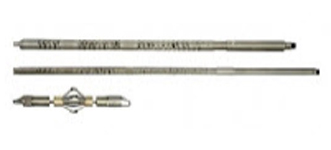
Cement bond tools measure the bond between casing and the cement placed in the annulus between the casing and the wellbore. Empire utilizes both 8 and 16 sector bond tools which allows us to provide clients with tubings from 4″ to 22″ a proper cemented casing evaluation.The measurement is made by using acoustic sonic.
The measurements of industry-standard sonic tools are usually displayed on a cement bond log (CBL) in millivolt units, decibel attenuation, or both. Reduction of the reading in millivolts or an increase in the decibel attenuation is an indication of better-quality bonding of the cement behind the casing to the casing wall.